
Washington's Tacklebox
The little things and what they hold.

The forecast called for rain so the blacksmith set up in a tent behind the library. Most years, he worked outside the old blacksmith shop that now served as the headquarters for the historical society.
He wasn’t alone in his displacement. The organizers of the Westhampton Fall Festival rescheduled their activities for the morning, a thankless task they accomplished with characteristic efficiency. My family has attended since we moved to Massachusetts thanks to an introduction by a friend whose aunt and uncle operate a farm in town. In past years the hamburgers, pulled pork sandwiches, hot dogs and French fries were available at a booth next to blacksmith, but that all moved to Town Hall under gathering clouds.
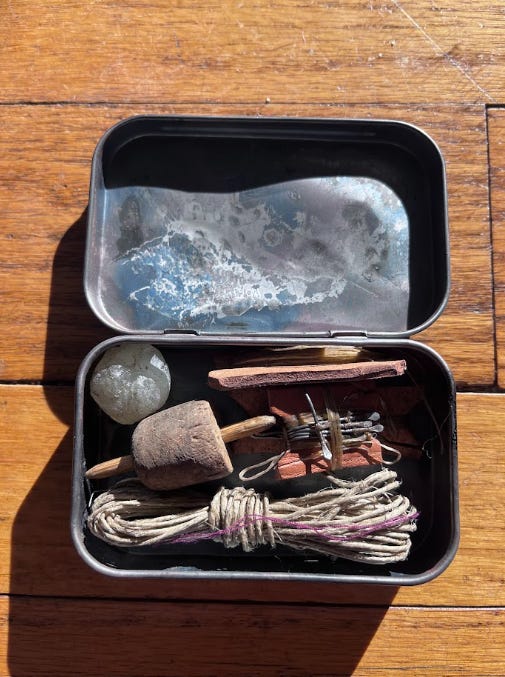
Inside the library, the lobby was full of tables where people sold local crafts. It was there that we met the blacksmith’s wife, who was managing a table full of his creations. Among them was a replica of George Washington’s tackle box. After seeing it, I went outside to talk to the blacksmith, Ted Hinman.
He sat amidst the thin smoke rising from hot coals, an anvil in front of him, his tools on a table to his left. When I asked about the tackle box, Hinman shared the research that led him to create this striking replica.*
The tackle box is roughly the size of a deck of cards. Inside are a ball of beeswax, several small books, and twine made of silk as well as horsehair. The blacksmith explained that the beeswax was used to strengthen the line as well as the tie between hook and line. A fisherman in Washington’s era would not necessarily bring a rod but instead pluck a piece of reed or a branch near the body of water where he came to fish. The eyehook, he told me, was not yet in use.
Washington would have carried a tackle box with him like this while surveying property, serving in the military, or on other voyages when the opportunity to fish might arise. Hinman first learned about these tackleboxes by watching a video on the Mt. Vernon website. Per the video…
George Washington enjoyed fishing both as a gentleman’s contemplative recreation and as a practical means of securing provisions while on the frontier. His diary records successful catches of a dolphin and shark in Barbados, a legendary catfish in the Ohio Country, and trout and perch during the recess of the Constitutional Convention in the hot summer of 1787.
I asked Hinman, who describes himself as having Asperger’s, what he thought about Washington’s relationship with slavery. Many people, I said, have chosen to turn away from treating Washington as a hero. Hinman gave it some thought.
“I’m interested in the technology. The Romans were detestable people,” he said, “but they invented concrete and I think that was an important contribution to civilization.”
We talked some more about the technology, how Washington likely ordered his kit from England. Hinman described the fishing operation at Mt. Vernon. He’d followed his interest in tackle to explorations of medieval China, Algonquin fishing camps, and the hooks used in ancient Egypt during the time of Moses. Hinman is an incredible artist. He encouraged me to visit him at his home studio, and I hope to make it happen this summer.
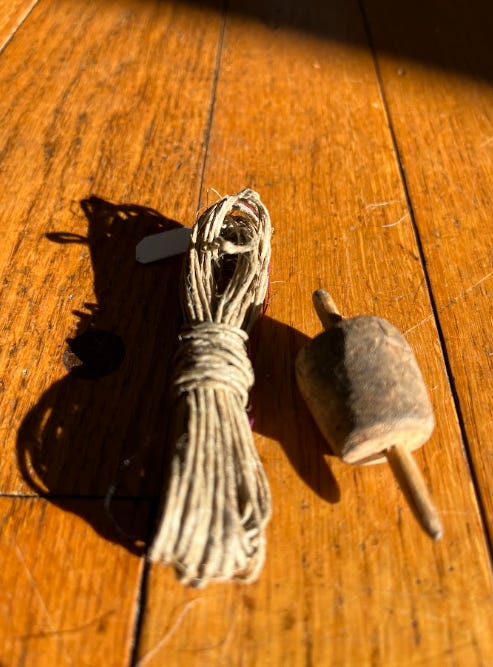
The tacklebox sat on my desk throughout 2026 like a miniature sphinx. Like the 250th, they seemed to suggest something deeper but out of reach, like a big fish that appears, steals your bait, then escapes to the depths, only to return and repeat the same maneuver.
With the 4th of July approaching, I picked the box back up this week and wondered again if I could make sense of this elusive fragment and why it speaks to me. I wondered why so many people seem unwilling to talk about the 250th, and what that silence is allowing to happen to history.
The kit, it seemed to me, reflected the empire in all its different materials. The tacklebox is based on one that Washington ordered from London in 1862. The trip to Barbados referenced in the video was an unsuccessful effort to cure his brother of tuberculosis. Lawrence Washington died on the coral island. It was also a chance to meet the English plantation society, the planters, judges, and generals who exploited the enslaved to build their own kingdoms of sugar and commerce. During one of those visits, Washington contracted smallpox. “If he had not suffered through smallpox in Barbados—and thus acquired a lifetime immunity to further infection—he might have died from the illness during the Revolutionary War.”
The fishing operation at Mt. Vernon was the work of enslaved individuals whose labor enriched Washington. In the most dehumanizing way imaginable, they were only technology, like those tackle. Washington’s surveying before the Revolutionary War was part of his scheming to acquire Native land beyond the border established by the Crown. Scholars argue that it was this lust for land that drove him to take up the cause of liberty.
The fishing trip during the Constitutional Convention recess was a chance to revisit another pivotal period in Washington’s life. He accompanied another founding father, Robert Morris, once thought to be the richest man in the colonies. One morning, Washington set out alone.
“Before breakfast I rode to the Valley Forge and over the whole Cantonment & Works of the American Army in the winter of 1777-8 and on my return to the Widow Moore’s found Mr. & Mrs. Rob. Morris. Spent the day there fishing & lodged at the same place.”
One can’t help but wonder what Washington thought as he viewed the old camp grounds. Today we think of Valley Forge as a crucible moment, a brutal winter when as many as 2,000 soldiers died. The rest, however, were hammered into a true army, one that went on to secure victory over the British.
All these histories come to me through the tacklebox. They all speak to why, for me, the 250th always seemed worthy of attention. Not because I am here to worship Washington, but because I want to know how we got here.
The celebrations reach their high point this week, thought there’s a substantial back stretch of events, publications, and learning remaining in its journey. Speaking of journeys, I was in Washington briefly early this week and I cannot emphasize enough how hot, empty, and confusing it felt to walk the Great American State Fair. Americans can’t be blamed for turning away from that sad, larcenous spectacle.
It’s never been a given that we accept this, of course. As I stare at that tacklebox, I wonder what small mementos we’ll hold in another 25 or 50 years. Whose lives will show up on the tables of the fall festivals? What histories will course through craft, and how can we replace myths with the heroism of those who struggled to outlast empires? That work will survive because so many Americans want to know how we got here. The will to wonder and the freedom to question—those are values I’ll remember beyond 2026.
I’m thankful for the many people who took that path this year.
Notes
*I spoke to Ted Hinman via phone a few months after the fall fest. You can see his work at www.tedhinman.com. His artist’s statement is a thing of beauty.
I dive deep into the work, able to see with a unique perspective, freed from the pressure to be “normal,” connecting with others in the creative space. When I am creating my art, I forget about my disability. I am able to create without judgment from others of me. I lose that sense of otherness I feel. I am at my happiest when I am creating my artwork. I can be myself, and I decide what direction my artwork will go, and I am not constrained by any rules. Art saved me, and now I use it to help others as well. Asperger’s actually empowers my award-winning work and inclusive teaching.
Interesting and sad at the same time. If only we knew more about those long lost times - again like the seal and motto discussions for MA - keep your chin up - MA can do better and you are a core aspect of that effort. Thanks and best wishes. VBR ANH